
Your receptionist is helping a patient check in when the phone starts ringing. Another patient is waiting to ask a question, someone needs to reschedule an appointment, and there are already several voicemail messages that still need a response.
For many medical and dental practices, this is not an unusual situation. It is simply part of a busy day.
The problem is that one person can only do so much at once.
That often leads practice owners and managers to ask an important question: Should we hire another in-house receptionist, or would a virtual receptionist be a better fit?
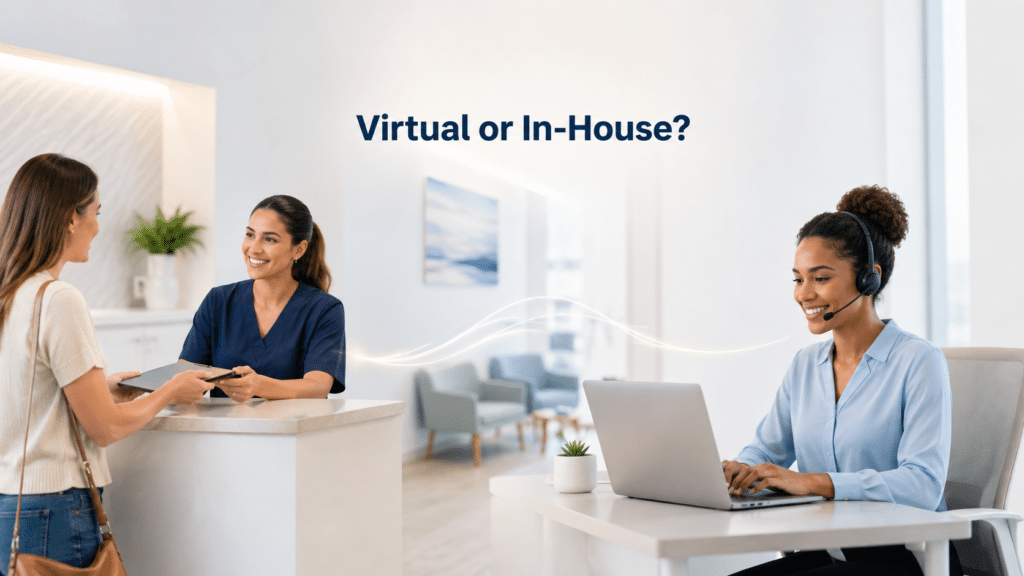
There is no single answer that works for every healthcare practice. An in-house receptionist is usually better for responsibilities that require someone to be physically present, while a virtual receptionist can be especially useful for calls, appointment scheduling, reminders, follow-ups, and other remote administrative work.
For many practices, the best solution may actually be a combination of both.
Quick Answer: Virtual Receptionist or In-House Receptionist?
An in-house receptionist is generally the better choice when your practice needs strong face-to-face patient support, physical check-in, paperwork handling, and on-site coordination. A virtual receptionist is often a better fit for incoming calls, appointment scheduling, patient reminders, routine follow-ups, and other administrative tasks that can be completed remotely.
If your biggest problem is a crowded reception desk, you may need more in-office help. If your biggest problem is missed calls and unfinished administrative work, virtual receptionist services may make more sense.
The first step is understanding where your front desk is actually struggling.
What Does an In-House Receptionist Handle?
An in-house receptionist is the person patients see when they walk through the door.
They may greet patients, manage check-in and check-out, collect paperwork, answer questions, process payments, handle telephone calls, schedule appointments, and communicate with providers and other staff members.
That physical presence matters.
If a patient needs help completing a form, has a question at check-in, or needs assistance before leaving the office, an on-site receptionist is there to help.
The difficulty comes when the same person is also expected to manage a constantly ringing phone.
Imagine trying to check a patient in while answering another patient’s scheduling questions on the phone. The person at the desk waits. The caller waits. The receptionist feels rushed.
This is often less about employee performance and more about how the workload has been structured.
What Does a Virtual Receptionist Handle?
A virtual receptionist performs front desk and administrative work from a remote location.
Remote support is already part of many team-based practice models. The American Medical Association notes that remote virtual assistants may help with work such as patient intake and follow-up appointment scheduling, when the role and workflow are appropriately designed. Read the AMA guidance on virtual assistants in private practice.
In a healthcare setting, their responsibilities may include:
- Answering patient calls
- Scheduling new appointments
- Rescheduling or cancelling appointments
- Confirming upcoming visits
- Managing voicemail
- Taking detailed patient messages
- Sending routine appointment reminders
- Following up with patients
- Collecting insurance information
- Supporting eligibility verification
- Coordinating referrals
- Requesting medical records
- Handling routine front desk enquiries
Because they are working remotely, a virtual receptionist is best suited to tasks that can be handled by telephone, computer, or practice-management software.
They cannot greet somebody walking into the office or physically collect paperwork at reception. But they can take a large amount of remote work away from the person who is doing those things.
That is where the value often becomes clear.
Virtual Receptionist vs In-House Receptionist: What Is the Difference?
Both roles support patients and help keep the practice organised. The main difference is where they work and which tasks they are best positioned to handle.
| Responsibility | Virtual Receptionist | In-House Receptionist |
| Incoming patient calls | Yes | Yes |
| Appointment scheduling | Yes | Yes |
| Appointment reminders | Yes | Yes |
| Routine follow-ups | Yes | Yes |
| Patient check-in | Remote support only | Yes |
| Face-to-face patient questions | No | Yes |
| Physical paperwork | Limited | Yes |
| Collecting in-office payments | No | Yes |
| Referral follow-up | Yes | Yes |
| Remote administrative work | Strong fit | Can handle |
| On-site support | No | Yes |
The biggest difference is not necessarily skill.
It is where each person can be most useful during the working day.
When Does an In-House Receptionist Make More Sense?
There are situations where having another person physically inside the practice is clearly the better choice.
Your Reception Area Is Extremely Busy
If patients are regularly lining up for check-in or check-out, adding remote phone support may not solve the entire problem.
You may simply need another person at the physical desk.
Your Practice Handles a Lot of Paperwork In Person
Some practices still depend heavily on printed forms, physical documents, payments, or other tasks that require an employee to be present.
An in-house receptionist is better suited to this kind of work.
Patients Need Frequent Face-to-Face Help
Certain practices have a higher level of in-person support than others.
If patients regularly need help understanding forms, directions, payment procedures, or other administrative issues during their visit, having enough on-site staff is important.
Your Team Requires Constant Physical Coordination
Some healthcare offices rely heavily on quick communication between reception, nurses, assistants, and providers.
Being physically present can make those conversations easier.
When Does a Virtual Receptionist Make More Sense?
A virtual receptionist may be a better fit when most of the problem is happening away from the physical desk.
Too Many Calls Are Being Missed
This is one of the clearest signs that additional phone support may be needed.
If your receptionist cannot answer because they are checking patients in, a virtual receptionist can take the call instead.
They may be able to answer the question, schedule the appointment, take a detailed message, or route the caller to the correct person.
A call handled the first time does not become another voicemail that somebody has to return later.
Staff Are Constantly Interrupted
Phone calls can be one of the biggest distractions at a busy healthcare front desk.
When a virtual receptionist takes more of the telephone workload, the in-office receptionist can spend more time helping the person who is actually standing in front of them.
That can make the entire reception area feel calmer.
Appointment Scheduling Takes Too Much Time
Scheduling may seem straightforward, but it can take up a significant portion of the day.
A healthcare virtual receptionist can handle routine booking, rescheduling, cancellations, and appointment confirmations once they understand the practice’s scheduling procedures.
This can reduce interruptions and help appointment requests get handled sooner.
Appointment reminders are also a recognised scheduling tool. The American Medical Association notes that automated texts, calls, or emails can help reduce no-shows while limiting additional work for the care team. Read the AMA guidance on appointment reminders and scheduling.
Follow-Ups Keep Getting Delayed
It is easy to push follow-ups to the end of the day.
Then the end of the day arrives, and there is still a long list waiting.
A virtual receptionist can take responsibility for routine reminders, callbacks, referral follow-ups, and records requests so these tasks are less likely to become a backlog.
Your Practice Is Growing
Growth does not always mean you need another person sitting behind the reception desk.
Sometimes the additional workload is mostly phone calls, scheduling, and administrative work.
In that situation, remote support may be a practical way to add capacity without expanding the physical front desk.
Which Option Is More Cost-Effective?
Cost is often one of the first things practice owners compare, but it should not be the only factor.
An in-house receptionist may involve expenses beyond salary or hourly pay. Depending on the employment arrangement, there may also be recruitment costs, training, equipment, office space, payroll-related expenses, and coverage requirements when the employee is absent.
Virtual receptionist services are usually structured differently. Costs may be tied more directly to the hours or level of support being provided.
That does not automatically mean a virtual receptionist is always the cheaper choice.
A better question is:
Which option solves the problem your practice actually has?
If the problem is that patients are waiting at the physical front desk, hiring remotely may not solve it.
If the problem is that the telephone rings all day and staff cannot keep up with scheduling, paying for another in-office workstation may not be necessary.
Efficiency comes from matching the staffing model to the workload.
What About Patient Experience?
This is one of the most important parts of the decision.
Patients generally care less about where the receptionist is sitting and more about whether somebody is available to help them.
When they call, does someone answer?
When they need an appointment, can they get one scheduled without unnecessary delays?
When they arrive at the office, is there someone available to help them check in?
Both types of receptionists support different parts of that experience.
An in-house receptionist is valuable for:
- Greeting patients
- Managing check-in
- Handling face-to-face questions
- Collecting paperwork
- Helping patients inside the office
A virtual receptionist can support:
- Faster call answering
- Appointment scheduling
- Routine reminders
- Patient callbacks
- Administrative follow-ups
Neither role has to compete with the other.
They can solve different problems.
Can a Virtual Receptionist and In-House Receptionist Work Together?
Yes, and for many healthcare practices this may be the most practical arrangement.
Instead of asking one receptionist to handle everything, the responsibilities can be divided.
For example:
The in-house receptionist could handle:
- Patient arrivals
- Check-in and check-out
- In-person questions
- Payments
- Physical paperwork
- On-site coordination
The virtual receptionist could handle:
- Incoming calls
- New patient enquiries
- Appointment scheduling
- Rescheduling
- Appointment reminders
- Routine follow-ups
- Referral coordination
- Records requests
- Front desk messages
This gives each person a clearer area of focus.
The receptionist inside the office does not have to stop helping a patient every time the phone rings. At the same time, the person calling the practice is more likely to reach someone who can actually help them.
That is often much more efficient than simply adding another person and having both employees manage the same mix of responsibilities.
How Do You Decide Which Model Your Practice Needs?
Start by looking at what is going wrong today.
Where Is the Bottleneck?
Is the problem at check-in?
Is it incoming calls?
Are appointment requests sitting in voicemail?
Are referrals falling behind?
Are staff staying late to return patient messages?
Once you know the bottleneck, the staffing decision becomes easier.
How Much Work Requires Someone to Be Physically Present?
If most of the unfinished work involves patient calls, scheduling, referrals, or routine follow-ups, much of it may be suitable for a virtual receptionist.
If the workload involves check-in, payments, physical paperwork, or constant face-to-face assistance, you probably need more on-site help.
Are Patients Waiting While Staff Answer Phones?
This is a useful warning sign.
If your receptionist regularly has to choose between the patient at the desk and the patient on the phone, the practice may benefit from separating those responsibilities.
Is Work Being Left Until the End of the Day?
Look at what is still unfinished when the doors close.
If staff are staying late to return calls, process messages, or complete routine follow-ups, the practice may need additional administrative capacity.
What Should You Look for in a Healthcare Virtual Receptionist?
Healthcare reception work is different from general customer service.
Before adding a virtual receptionist, consider asking:
- Do they have healthcare experience?
- Have they supported medical or dental practices before?
- Are they comfortable with patient scheduling?
- Can they work with your practice-management or EHR systems?
- How do they handle patient information?
- What privacy and security training have they received?
- How are urgent calls escalated?
- How is their performance managed?
- What happens if they are unavailable?
- Can their responsibilities expand as your practice grows?
Communication skills matter, but healthcare workflow knowledge matters too.
Privacy and security should be part of the decision from the beginning. If a virtual receptionist creates, receives, maintains, or transmits protected health information on behalf of a HIPAA-covered practice, the practice should determine whether the provider is a business associate and ensure the appropriate safeguards and written agreement are in place. See the U.S. Department of Health & Human Services guidance on business associates. The HIPAA Security Rule also requires appropriate administrative, physical, and technical safeguards for electronic protected health information. Read the HHS HIPAA Security Rule overview.
A receptionist who understands the environment may be able to become productive more quickly and require less basic training.
So, Which Is Better for Your Practice?
There is no universal winner.
If your biggest challenge is supporting patients physically inside the office, an in-house receptionist may be the better choice.
If your team is struggling with calls, scheduling, reminders, and administrative follow-ups, a virtual receptionist may be more useful.
For many practices, however, the answer is not choosing one or the other.
It is allowing each person to focus on the work they are best positioned to handle.
That could mean keeping your current front desk team exactly where they are while moving more telephone and administrative responsibilities to a remote receptionist.
The result can be better call coverage, fewer interruptions, a more organised workflow, and more attention for patients inside the practice.
How Vital Virtuals Can Support Your Front Desk
Vital Virtuals provides healthcare-focused remote professionals who can support medical and dental practices with front desk and administrative responsibilities.
Depending on the needs of the practice, a virtual receptionist may assist with patient calls, appointment scheduling, reminders, front desk communication, insurance-related administrative work, referrals, medical records, and routine follow-ups.
The goal is not to make your front desk less personal.
It is to give your existing team enough support to provide better service.
When the person inside the office has time for the patient standing in front of them, and the patient calling the practice can also reach someone who can help, the front desk works the way it should.
Frequently Asked Questions
Is a virtual receptionist better than an in-house receptionist?
Neither option is automatically better. An in-house receptionist is usually better for face-to-face and physical front desk responsibilities, while a virtual receptionist is well suited to calls, scheduling, reminders, and remote administrative work.
Can a virtual receptionist replace an in-house receptionist?
In some practices, a virtual receptionist can handle a large percentage of administrative work. However, tasks such as physical patient check-in, collecting paperwork, and face-to-face assistance still require someone on-site.
What tasks are best handled by a virtual receptionist?
Virtual receptionists are particularly useful for patient calls, appointment scheduling, cancellations, reminders, routine callbacks, referral follow-up, medical records requests, and other remote administrative tasks.
What tasks require an in-house receptionist?
Patient check-in and check-out, physical paperwork, in-person payments, face-to-face questions, and other tasks requiring someone to be present generally need an in-house employee.
Can virtual receptionists schedule medical appointments?
Yes. Once they are trained on the practice’s appointment types, providers, scheduling rules, and systems, a virtual medical receptionist can help manage routine appointment bookings, cancellations, rescheduling, and confirmations.
Can a virtual receptionist work with our existing front desk staff?
Yes. This is often one of the most useful ways to structure the role. The virtual receptionist can take responsibility for calls and remote administrative work while the in-office team focuses on patients at the practice.
Are virtual receptionists suitable for dental practices?
Yes. Dental virtual receptionists may support appointment scheduling, patient calls, reminders, recalls, insurance-related administrative tasks, and other front desk responsibilities.
How do I know if my practice needs a virtual receptionist?
If staff frequently miss calls, patients spend too long on hold, scheduling requests are delayed, routine follow-ups are falling behind, or employees regularly stay late to finish administrative tasks, additional virtual front desk support may be worth considering.
What should I look for when hiring a healthcare virtual receptionist?
Look for healthcare experience, strong communication skills, familiarity with patient scheduling and practice-management systems, appropriate privacy training, reliable technology, and a clear understanding of when calls should be escalated.
How can Vital Virtuals help medical and dental practices?
Vital Virtuals provides healthcare-focused virtual assistants who can support front desk operations, including patient calls, scheduling, communication, referrals, records coordination, and other routine administrative workflows.